It’s entirely possible that the repeated electrical and mechanical failures of the Jaws animatronic shark, Bruce, are responsible for the casting of Richard Dreyfuss as Roy Neary in Close Encounters of the Third Kind (CE3K). Rumour has it, while filming Jaws, Steven Spielberg took meetings and discussed what would become CE3K, Back to the Future, Raiders of the Lost Ark, 1941, and E.T. That’s a pretty incredible lineup, but no surprise for one of the greatest film producers and directors of his generation. While awaiting Bruce’s repair, and other delays, Jaws went way over time, and Spielberg was convinced he’d be drummed out of the industry. But it gave Dreyfuss (who portrayed Matt Hooper in Jaws) the opportunity to consistently harangue Spielberg into casting him as the lead character in CE3K.
Spielberg had doubts of course, and was considering Steve McQueen, Al Pacino, Dustin Hoffman, James Caan, Jack Nicholson, Robert De Niro, and Gene Hackman (Jesus, that’s a lineup). Dreyfuss hatched a plan, and slowly worked away at the director:
“I would walk by Steve's office and say stuff like 'Al Pacino has no sense of humor' or 'Jack Nicholson is too crazy'. I eventually convinced him to cast me."
While I’m fairly certain that any of those gentlemen would have provided a better than adequate Roy Neary, I’m glad that Dreyfuss was successful in convincing Spielberg. It’s doubtful that we would have received quite the performance that Dreyfuss gave us from any of the others under consideration.
For those who aren’t familiar with Close Encounters of the Third Kind, here’s a rough plot synopsis:
A team of scientists from the United Nations are investigating a series of unusual re-appearances of famously missing planes and boats, etc. Meanwhile, several people worldwide are experiencing baffling interactions with what appears to be extra terrestrials. Roy Neary, an electrical lineman from Indiana, is especially impacted by his encounter. Neary works with Jillian, similarly-afflicted mother of the abducted toddler, Barry, to understand what has happened to them. Adventure ensues.
But if I think back to my youth, watching this film mostly with my father, my focus was not on Dreyfuss. I thought the portions of the film that followed him and his family were the most boring. I wanted more revelations of missing Navy pilots and entire Indian villages ensorcelled by music from the sky. As a nascent musician and composer, I was even more interested in the UN team’s musical method for attempting communication with the extraterrestrials. This eleven year old wasn’t interested in a grown man descending into madness due to alien interference and intrusive visions of a national monument.

This means something. This is important.
I suppose as one matures, and acquires more knowledge about the world, and more experience with the vagaries of life, they are capable of understanding the pressures of adulthood. Roy Neary has a fairly mundane life. A wife, three children, and a solid if unspectacular career. He’s certainly not the greatest father, as the events of the film reveal, but he’s not inattentive to his children either. He appears to care about entertaining them, and wants them to experience some culture, namely the Disney Pinocchio and The Ten Commandments. He’s somewhat quick to temper, but simultaneously capable of admitting fault.
Okay, I'm wrong. I'm wrong. I'm Wrong Roy, all right? (as Toby, far too old for this behaviour, proceeds to bash the fuck out of a baby doll)
Toby! You are close to death! Come out here!
It’s safe to say that Roy cares enough about his family that he intends to toil as a linesman to provide for them. Though they do bicker, he appears to genuinely love his wife, Ronnie. By all measures, though he’s no Ward Cleaver, Roy is a mensch.
But there are demons circling Roy. His encounter with aliens has him unraveling at the seams. This manifests in two ways, both equally baffling to him. Firstly, he cannot explain his encounter in rural Indiana and the ensuing experiences. He suspects the UFO’s he’s seen are exactly what they appear to be: extraterrestrial life. He demands answers from authorities, and will not be dissuaded by banal explanations. Secondly, the experiences have left him with unwanted and persistent visions. He simply cannot unsee the Devil’s Tower monument (though he does not know what it is) branded in his mind.
At first he attempts to craft the monument in shaving cream, graduating over a series of days through mashed potatoes and model train set clay, eventually to an eight foot tall laccolithic butte in his living room. To achieve the latter, he dismantles his wife’s garden, and pilfers items from his neighbour. He lays prone in his master bathroom shower, door locked, fully clothed, deluged with hot water and steam, ignoring his wife’s frantic pleas. Roy stands in his backyard, railing against the sky, demanding clarity.
He repeatedly implores his family that he has no idea what's happening to him. I find this fascinating because no one has any idea what's happening to him. This is the first time that anything like this has happened to anyone. There is no known therapy, no prescribable remedy for what ails him. This makes his unhinged behaviour entirely rational.
However, his behaviour has a deep impact on his family. Ronnie is completely beside herself in attempting to understand Roy. He’s been fired from his job, obsessively collecting every piece of information about alien encounters that he can, and embarrassing her in the community with his conduct. Despite his protestations, at her wit’s end, she flees with the children, not to be seen again. His daughter and youngest son (Silvia and Toby) are clearly traumatized, but appear to be quietly lamenting the situation. Brad, his eldest, on the other hand, is loudly making the situation much worse (and who can blame him). In a viscerally poignant scene, after Ronnie turns off the shower, Brad yells at Roy.

Crybaby! You crybaby!
We are watching Close Encounters of the Third Kind. But, like Jaws, which is not actually a bout a shark, CE3K is not about aliens. We are watching the collapse of a man.
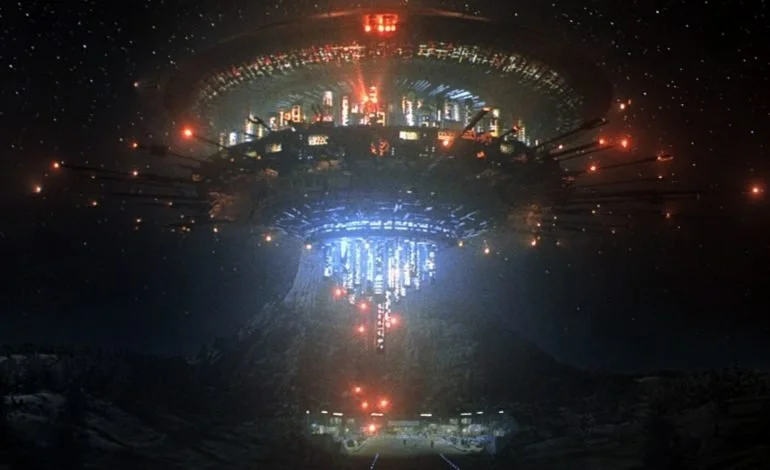
Eventually, Roy gets some answers. After following his compulsion, he arrives at Devil’s Tower with Jillian, where the UN Team and the military have setup a base to greet arriving aliens. Communicating by a sophisticated but elegant language of musical tones, the humans and the aliens come to understand each other. After the return of those who have been missing from as far back as the 1940’s, and Jillian’s reunion with Barry, Roy is offered the opportunity to join the aliens. Presumably he will travel the stars. Spielberg fires every arrow in his artistic quiver to convince the viewer that Roy has been invited here by the aliens, an explanation for his visions and obsession. He boards the ship, which leaves earth over some of John Williams’ finest work, and the film concludes.
Steven Spielberg has said that upon becoming a husband and father, had he made the movie today, he would not have Roy Neary leave his family. While I completely understand Spielberg’s impulse to protect his family (probably as strong as Roy’s impulses to find answers), I think that alternate ending to the film would have been a shame. Roy is certainly not a good person for leaving his family, even for such an eventful and purposeful quest. However, even a fictional hero (and especially a fictional anti-hero) is rightly afforded opportunities to engage in plot-advancing shenanigans. In this context, it’s entirely necessary for Roy Neary to go to the stars.
G, A, F, (octave lower) F, C
